Social Media Marketing: Building a Strong Brand Presence
Let's face it, social media isn't just about cat videos and catching up with old friends anymore, it's a game changer for businesses big and small.
With nearly 5 billion people scrolling, liking, and sharing across platforms worldwide, your business needs to be in the mix. Whether you’re a local restaurant or a growing tech startup, social media offers a direct line to your audience, helping to boost your brand, build a loyal following, and even bump up your sales.
In this ultimate guide, we’ll talk about the essentials of social media marketing. You'll learn what it is, how it all works, and the top strategies you can use to make social media work for you. Ready to start connecting? Let’s get into it.
What is social media marketing?
Think of social media marketing as the art of grabbing attention and engaging with folks through platforms like Facebook, Instagram, Twitter, LinkedIn, and TikTok. If you're running a small business, weaving social media into your marketing mix isn't just a good idea, it's essential.
Crafting a solid social media marketing plan is key. Your audience expects more than just run-of-the-mill posts; they're looking for engaging content and real-time interactions with your brand, whether that's through comments or direct messages.
But here’s the real kicker: social media marketing isn’t just about posting updates and responding to comments. It’s a chance to bring your brand’s personality to life, drive traffic to your website, and boost conversions. Through targeted ads, you can also reel in leads and ramp up your sales, all while building brand awareness.
Plus, it’s a fantastic tool for customer service. More and more, customers prefer to drop a message on social media to get their issues sorted quickly. So, by being active and responsive, you’re not just marketing; you’re providing top-notch service that keeps customers coming back for more.
Importance of social media for brands
In the digital age, social media is the town square. Social media gives you a unique opportunity to shape your brand’s narrative, showcase your values, and communicate directly with your customers. It’s where your brand can be discovered, discussed, and remembered.
Plus, it provides invaluable insights into what your audience wants and needs, enabling you to tailor your offerings and messages precisely.
Key benefits of a strong social media presence
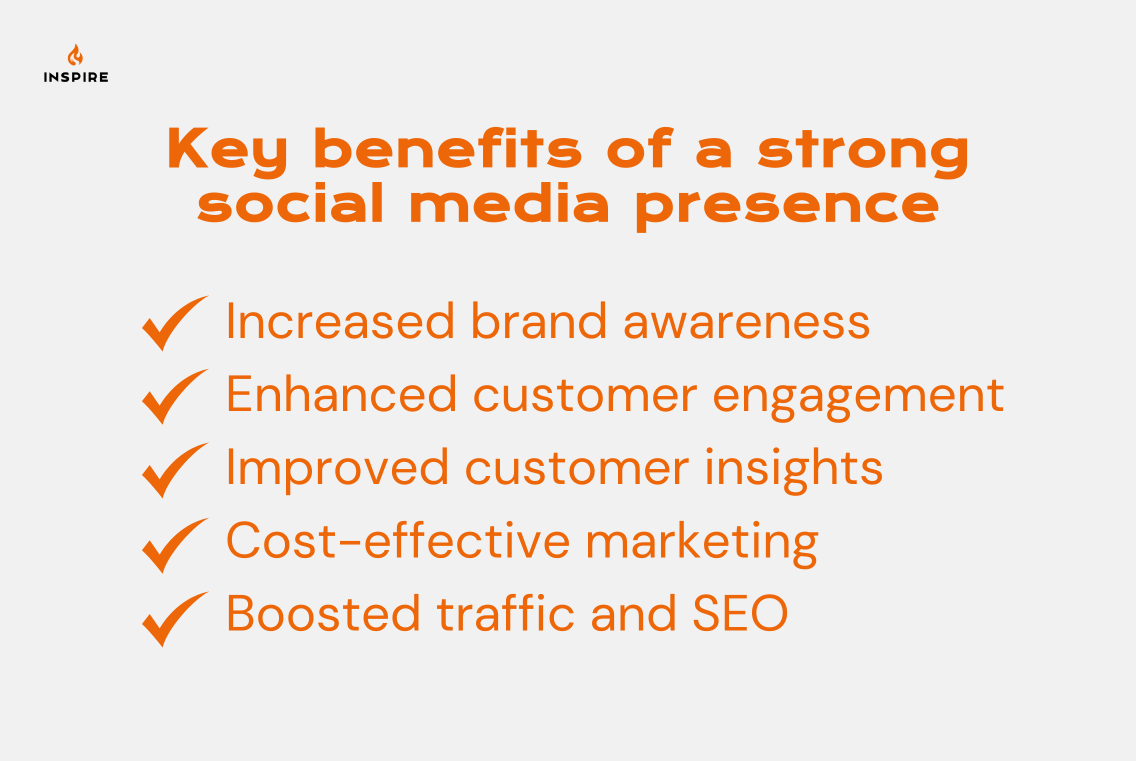
Building a robust social media presence can transform your business in several powerful ways:
Increased brand awareness
Every post shared, every like received, and every comment made increases the visibility of your brand. The more you engage, the more familiar and recognizable your brand becomes.
Enhanced customer engagement
Social media is a two-way street that allows you to engage directly with customers and prospects. This interaction not only builds relationships but also fosters trust and loyalty.
Improved customer insights
Social platforms offer tools that provide real-time data on how your content is performing. These insights allow you to understand customer behaviour, preferences, and trends, helping you make informed business decisions.
Cost-effective marketing
Compared to traditional marketing channels, social media can be a more affordable option that offers targeted advertising and organic opportunities to reach a broad audience.
Boosted traffic and SEO
Regular and strategic posting on social media can drive more traffic to your website, enhancing your search engine optimisation efforts and increasing your online visibility.
By leveraging these benefits, a strong social media presence can be a cornerstone of your brand’s success in the digital marketplace. Ready to dive deeper? Let’s explore how to put these strategies into action and maximize your social media impact.
Platform-specific strategies
There are over 20 major social media platforms vying for your attention.
But here's a pro tip: don’t try to conquer them all.
Instead, pick where to focus your energy based on your social media marketing strategy.
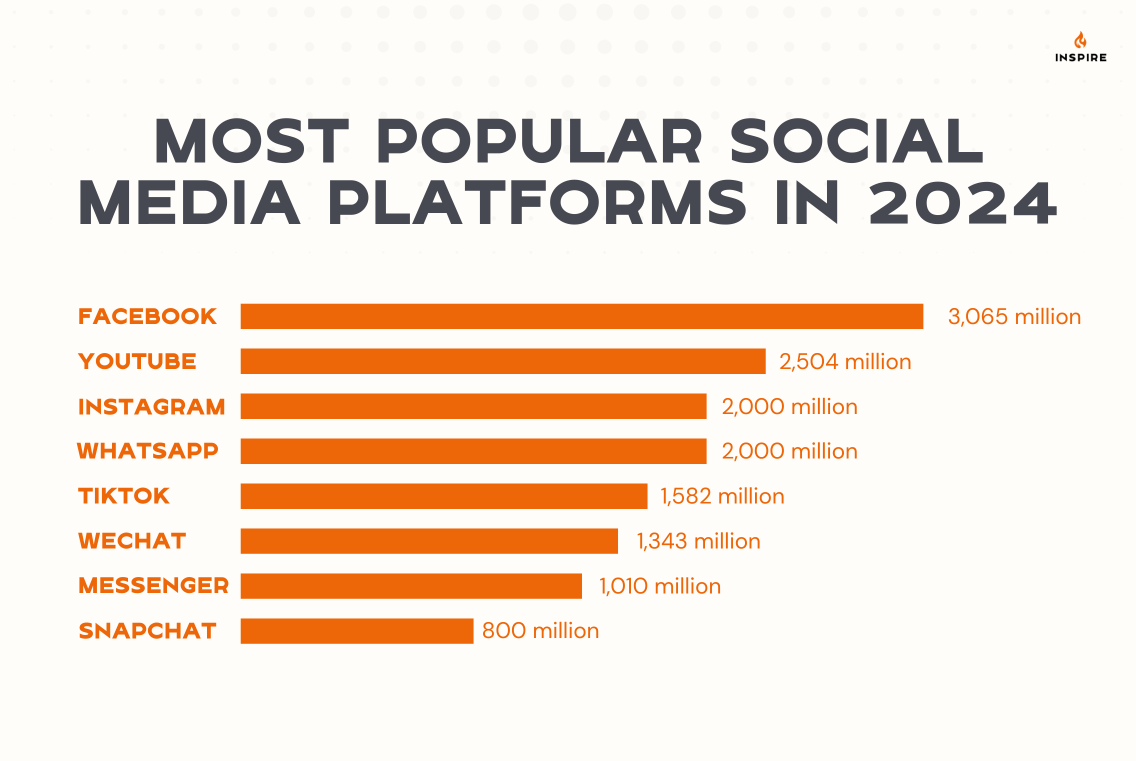
Looking at the latest trends from 2023, the hotspots for marketers are Facebook, LinkedIn, Instagram, X (formerly Twitter), YouTube, and TikTok. These are the big leagues where you’ll likely find your audience.
social media marketing platforms So, how do you choose the right platforms for your brand?
It all boils down to knowing where your audience likes to hang out. Let’s simplify things with a quick overview and a peek at who’s using these top social networks to help you make the best choice.
Facebook marketing
Facebook is a giant playground for over 3 billion active users every month. That's right, more than a third of the entire planet checks in here at least once a month.
With users spanning from the young at heart to the more seasoned adults, the platform sees a vibrant mix of 77% women and 61% men, with the largest group being those aged 25-34.
It's no wonder that 89% of organisations use Facebook for their social media efforts. This platform is a powerhouse that supports all kinds of content, from quick text updates and breathtaking photos to engaging videos and speaking of videos, they're the real stars here.
Owned by Meta, Facebook also offers some robust tools for marketers. Whether you're diving into Meta’s Business Suite or crafting targeted campaigns in Facebook Ads Manager, this platform gives you all you need to connect with your audience in meaningful ways.
Creating and managing Facebook pages
Setting up a Facebook Page for your business or project is like opening a new storefront on the busiest street in town. It's where you can showcase what you're all about, share updates, and really connect with your audience.
Starting is straightforward: you choose a page name that reflects your brand, add a compelling profile and cover photos, and fill in your business details to help people find you.
Once your page is live, managing it is all about keeping the content fresh and engaging. Here's how:
- Post regularly about new products, special events, or interesting facts.
- Use high-quality images or videos to catch the eye
- Don't forget to interact with your followers by responding to comments and messages. This not only boosts engagement but also builds a community around your brand.
Facebook ads and targeting
When you’re ready to take your social media marketing to the next level, Facebook Ads are the way to go. With Facebook’s incredibly detailed targeting options, you can reach exactly who you want to, whether it’s by age, interests, location, behaviour, or even connections. You can tailor your ads to appear to potential customers who are most likely to be interested in what you offer.
Creating an ad is more than just putting up a picture and some text. It’s about telling a story that resonates with your target audience. You can choose different formats depending on your goal, like image ads for brand awareness, video ads for engagement, or carousel ads to showcase multiple products.
And with tools like Facebook Ads Manager, you can track how your ads perform, make adjustments in real-time, and optimise your spending to get the best return on your investment. It’s a dynamic way to ensure your marketing efforts are as effective as they can be.
Instagram marketing
Instagram is like the image-driven magazine of social media, boasting a whopping 2 billion active users each month. The platform skews slightly younger, with its largest groups being 18-24-year-olds, closely followed by the 25-34 crowd. It’s a pretty balanced mix too, with 44% women and 36% men scrolling through their feeds.
A favourite for 84% of organizations diving into social media marketing, Instagram is all about the visuals such as photos, carousels (those swipeable multi-photo posts), Stories, Reels, and even live videos light up the platform.
From what we’ve seen analysing millions of posts, if you really want to grab attention and drive engagement, Reels are your best bet.
They're short, snappy, and super shareable, perfect for catching the eye of Instagram's dynamic and creative users. So, whether you're showcasing a behind-the-scenes look at your process or jumping on the latest trend, Reels are the way to go to keep your audience engaged and interacting.
Building an Instagram following
Growing your Instagram following is about much more than just numbers; it’s about creating a community that engages with and supports your brand.
Start by ensuring your profile is complete with a bio that captures the essence of what you do and includes a clear call to action. Your content is crucial; it should not only be visually appealing but also consistent in style and tone, making your feed a visually cohesive space.
Engage actively with your audience by liking, commenting on, and sharing their content, as well as responding to comments on your posts. Use relevant hashtags to increase your visibility and findability.
Collaborations with other Instagrammers and influencers in your niche can also help you reach a broader audience. Remember, authenticity wins on Instagram, so keep your interactions genuine and your content true to your brand.
Instagram stories and reels for engagement
Instagram Stories and Reels offer dynamic ways to engage with your audience. Stories, which disappear after 24 hours, are perfect for sharing more spontaneous and behind-the-scenes content. They’re a great tool for daily updates, time-sensitive offers, or just fun interactions with your audience through polls and Q&A features.
Reels, on the other hand, are Instagram’s answer to the short-form video trend. They allow you to create engaging, creative videos set to music, which can help you reach a wider audience due to their favoured status in Instagram’s algorithm. Both Stories and Reels feature interactive elements like stickers, countdowns, and swipe-up links that can drive traffic to your site and increase engagement.
Using Stories and Reels effectively involves tapping into current trends, using eye-catching visuals, and maintaining a regular posting schedule to keep your audience coming back for more. These formats are powerful tools in your engagement toolkit, helping to make your brand more relatable and accessible to your followers.
LinkedIn marketing
LinkedIn stands out as the professional hub of social media, making it a goldmine for B2B marketers. It’s where industry leaders share insights, companies post updates, and professionals network. If your goal is to establish authority and build professional relationships in your industry, LinkedIn is the place to be.
Effective LinkedIn marketing begins with a well-crafted company page that clearly communicates your brand’s mission, vision, and values. Share content that adds value, think insightful articles, industry research, and company news that positions your brand as a thought leader. Regular updates keep your audience engaged and showcase your expertise.
Leveraging LinkedIn for B2B marketing
For B2B companies, LinkedIn is particularly powerful. It’s an ideal platform for generating leads, improving brand visibility, and establishing credibility.
Engage with other businesses by participating in LinkedIn Groups, commenting on posts, and sharing relevant content. Networking here means creating meaningful interactions that can lead to partnerships and opportunities.
LinkedIn ads and sponsored content
When you’re ready to amplify your reach, LinkedIn Ads and Sponsored Content can help. These tools are designed to target professionals based on job title, industry, company size, and even skills, ensuring that your marketing efforts reach the most relevant audience.
LinkedIn Ads come in various formats, from simple text ads to more engaging video ads, while Sponsored Content appears directly in the news feed, blending naturally with organic posts. This type of content is ideal for promoting white papers, articles, or events, driving not just views but also actions.
Utilising LinkedIn’s advertising options allows you to track conversions, measure engagement, and refine your strategies based on data-driven insights. Whether your goal is lead generation or brand awareness, LinkedIn’s marketing tools offer a tailored approach to reach professionals in a context that’s already geared towards business.
X (Twitter) marketing
X is a fast-paced microblogging platform where news breaks, trends take off, and conversations happen in real-time. For brands, it's an invaluable space to engage audiences quickly and directly. Effective X marketing hinges on your ability to join and drive conversations relevant to your industry or interests.
To thrive on X, keep your messages clear and concise.
Regular posting and quoting relevant content can help maintain visibility in your followers' crowded feeds.
Use hashtags wisely to join broader conversations and increase your reach. It's also crucial to monitor your mentions and respond promptly, as Twitter users expect quick interactions.
Engaging audiences on X
Engagement on X is about sparking dialogue and interacting with your audience. Live tweeting during events, hosting Q&A sessions, and participating in or starting Twitter chats based on your niche can significantly increase engagement.
Also, consider using polls to gather opinions or feedback, it’s a simple yet effective way to encourage participation and gather valuable insights from your audience.
Content that tends to perform well on X includes infographics, short videos, and visually appealing images. These can help break through the text-heavy nature of X and catch the eye of scroller.
Personalising your replies and acknowledging followers’ tweets also build a stronger connection and encourage more interaction.
Using X ads effectively
When you’re ready to extend your reach beyond your existing followers, Twitter Ads offer a powerful way to target new audiences. These ads can be tailored to meet various marketing objectives, from building brand awareness to driving website traffic or conversions.
X's ad platform allows you to target users based on their interests, demographics, behaviours, and even keywords they’ve tweeted. This makes your ads more relevant to the users who see them, increasing the likelihood of engagement.
For maximum impact, utilise X's different ad formats such as Promoted Posts, Promoted Accounts, and Promoted Trends. Promoted posts look like regular tweets but are shown to more people who find your content relevant. Promoted Accounts help increase your follower count by suggesting your account to targeted users, while Promoted Trends get your hashtag at the top of the trending topics, making it visible to millions.
Overall, X is a dynamic platform for engaging with audiences in real-time and enhancing your brand’s visibility. With the right strategy and a bit of creativity, it can be an effective tool in your marketing arsenal.
TikTok marketing
TikTok is the new kid on the block in the social media world, but it's quickly become a powerhouse, boasting over 1 billion monthly active users. It's particularly popular with the younger crowd, with 18 to 24-year-olds dominating the platform. Though more women (24%) than men (17%) are scrolling and creating, it's a vibrant space for all.
About 30% of organisations have already tapped into TikTok for marketing, attracted by its rapid growth and the creative freedom it offers. On TikTok, you can whip up videos ranging from quick 15-second clips to more detailed 10-minute narratives. The platform is a creator's playground, loaded with an array of filters, AI effects, catchy sounds, and music tracks that make each video unique and engaging.
And there’s more... TikTok isn’t just sticking to videos. It’s expanded its repertoire to include Stories and carousel-style photo posts, giving users and brands more ways to express themselves and connect with audiences. Whether you’re looking to entertain, inform, or inspire, TikTok offers a dynamic and fun way to engage with a global audience.
Content creation and curation
Over the last few years, crafting content for the web has evolved way beyond simple writing. Bloggers everywhere are mixing it up, adding various elements to their posts to keep readers hooked and hanging around longer.
While sharp writing skills are still your bread and butter, spicing things up a bit can really capture your audience’s attention.
And let’s be honest, with the internet overflowing with content, standing out is not just nice... it’s necessary. So, please don't shy away from throwing a little extra flair into your work to make it pop!
Types of content that perform well
Some content types consistently attract more eyeballs and engagement:
Short-form video
In 2024, short-form videos continue to dominate social media strategies, with many marketers increasing their investments:
- 67% plan to boost their investment in short-form videos.
- 31% intend to maintain their current spending.
- 33% will prioritise short-form videos over all other types of content.
This focus isn't surprising, given that short videos have been shown to offer the highest return on investment (ROI) for social media marketing, according to HubSpot's 2024 Social Media Trends Report.
Popular formats include TikTok videos, Instagram Reels, and YouTube Shorts.
Live video
Don't overlook live video, which surged in popularity during the pandemic as a way to participate in events remotely. Social media platforms like Twitch allow viewers to interact with creators in real time. This format is reported to have the second-highest ROI, according to 57% of marketers.
Long-form video
While long-form videos are costlier and generally yield a lower ROI compared to short-form, they still have a place in the content mix. These videos require higher production quality and often struggle to retain viewer attention throughout. However, you can extend their value by repurposing longer content into several short clips, maximizing your resources and keeping your audience engaged across different platforms.
User-Generated Content (UGC)
User-generated content is any material, photos, videos, reviews, tweets, created by your audience that showcases your brand without any direct investment from your side.
Picture this: a customer posts an un-sponsored TikTok raving about your product, or someone uploads a photo wearing your product and tags your company.
This type of content is gold for social media marketing. It provides authentic proof that real people not only use but also enjoy your products.
Essentially, it’s your customers doing the marketing for you, because sometimes, letting others sing your praises speaks louder than any ad campaign.
The impact? Significant. Studies show that nearly 80% of consumers are swayed more by user-generated content than traditional branded posts or even influencer endorsements. People trust their peers, making UGC incredibly persuasive.
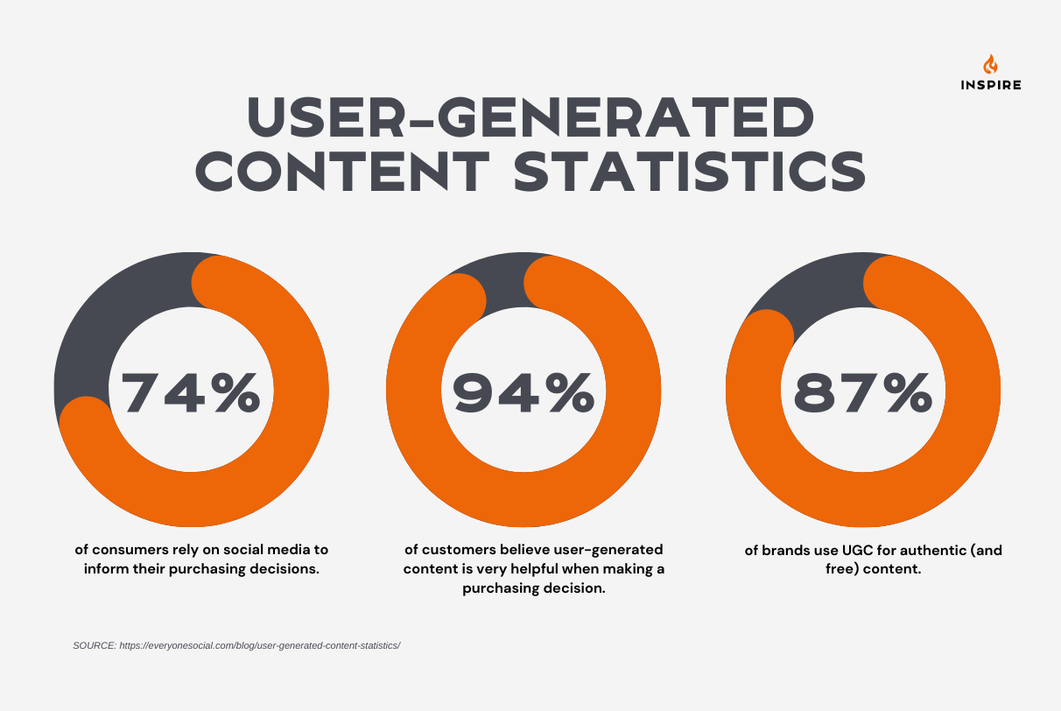
When it comes to distribution, user-generated content performs exceptionally well on platforms like YouTube (26% effectiveness), Instagram (24%), and Facebook (21%). Leveraging UGC on these channels can boost visibility and credibility, influencing purchase decisions in a way that feels organic and genuine.
Educational content
Educational content is all about delivering valuable information that empowers your audience, helping them achieve their objectives or solve specific problems. This type of content can be packaged in various forms, whether it’s infographics, videos, text posts, or images; really, any format that effectively conveys information.
Some frequently use YouTube to share educational content, offering viewers in-depth insights into various marketing concepts. A great instance is a video on how to create a brand style guide, which provides clear, actionable advice on establishing a consistent brand identity.
Expanding further, educational content doesn't just inform, it engages. By incorporating quizzes, interactive videos, or even step-by-step tutorials, you not only provide knowledge but also make the learning process engaging and interactive. This approach not only increases the likelihood of your content being shared but also enhances its impact, helping to establish your brand as a trusted authority in your field.
Trendy and relatable content
Capturing the magic of a viral post is the holy grail for social media marketers. Though they're rare, you can boost your odds by tapping into the latest memes, linking them cleverly to your brand, and riding the wave of trending hashtags or sounds.
Creating this kind of content demands a keen sense of what's buzzing online, staying tuned into cultural moments and current events is key.
Already, over 40% of marketers are spicing up their feeds with funny, trendy, and relatable posts, and 59% plan to up their game on the humour front in 2024, as it’s proven to be the most engaging approach.
And guess what?
Consumers are here for it. They're eager for a good laugh and appreciate brands that can deliver authentic, quality humour.
Take a look at this ad campaign from Stabilo:

Highlighters might not be the first thing you associate with a good laugh. They're practical tools, often found in the stress-inducing realms of school desks and office paperwork. Yet, Stabilo has turned this narrative on its head by injecting humour that not only fits perfectly with the context (think blocks of text) but also carries a clever, underlying message that makes you stop and think.
Their approach is authentic, straightforward, and even a bit self-deprecating. By embracing this style of humour, Stabilo manages to make their brand more memorable and lighten up the typically serious atmosphere surrounding their products.
Best Practices for Content Creation
Creating compelling content is both an art and a science. Here are some foundational best practices that can elevate your content strategy:
Know your audience
Understanding your audience is the cornerstone of effective content creation.
Dive deep into who your audience is... what are their interests, needs, and behaviours?
Use this knowledge to tailor your content specifically to them. This could mean adopting the tone they resonate with, addressing their pain points, or simply discussing topics they care about.
Tools like audience analytics and surveys can help you get a clearer picture of your audience's preferences.
Consistency is key
Consistency isn’t just about frequency, it’s about being reliable in the quality and type of content you deliver. Setting a social media content calendar can help maintain a steady flow of content, ensuring that your audience knows when to expect new material from you.
This regularity helps build a habit in your audience's consumption patterns, which can strengthen their loyalty and engagement with your brand.
Quality over quantity
In the vast sea of content online, quality can set you apart.
Focus on creating content that provides real value rather than just filling your feed with posts.
High-quality content is informative, engaging, and relevant, making your audience more likely to share it and come back for more. Remember, a few well-crafted pieces can have a greater impact than numerous mediocre ones.
SEO optimisation
SEO is crucial for making sure your content reaches your audience through search engines.
Use relevant keywords naturally, optimise your meta tags and descriptions, and ensure your content is accessible and easy to navigate. Keeping up with SEO trends and guidelines can also help your content gain visibility and attract organic traffic.
Beyond keywords, consider the user experience on your website, as factors like loading speed, mobile-friendliness, and easy navigation can also affect your SEO rankings.
By integrating these practices into your content strategy, you not only enhance the effectiveness of your content but also build a stronger, more engaged audience over time.
Social media advertising
Social media advertising is a powerful tool for brands to increase visibility, drive sales, and grow their audience. By leveraging the vast user bases of platforms like Facebook, Instagram, LinkedIn, and Twitter, businesses can target specific demographics with unprecedented precision.
Ad formats and marketing strategy
Each social media platform offers a variety of ad formats tailored to different marketing goals and user experiences. Here’s a breakdown of some of the key formats and strategies:
Photo and video ads
These are the bread and butter of social media advertising. Photo ads offer a clean, simple format that's great for showcasing products and services. Video ads can be more engaging, telling a story or demonstrating a product in action. Both formats work across platforms and are effective for driving high engagement.
Carousel ads
These allow you to showcase multiple images or videos in a single ad, each with its own link. They're perfect for highlighting different features of a product or telling a step-by-step story that unfolds with each swipe.
Stories ads
Available on platforms like Instagram, Facebook, and Snapchat, Stories ads are full-screen vertical ads that appear between stories from friends and family. They are highly visual and designed to capture the full attention of the viewer for a short period, making them ideal for time-sensitive offers or promotions.
Sponsored posts
These ads look like regular posts but are paid for to reach a broader audience. They can be used to increase reach, enhance brand awareness, and generate engagement through likes, comments, and shares.
Interactive ads
Some platforms offer interactive elements like polls, quizzes, and augmented reality filters, which can dramatically increase user engagement and time spent interacting with the ad.
Strategies for effective social media advertising
- Targeting: The success of social media advertising largely depends on how well you target your ads. Platforms offer robust targeting options based on demographics, interests, behaviours, and more. Effective targeting ensures that your ads are seen by the users most likely to be interested in your products or services.
- A/B testing: Regularly testing different versions of your ads can help you understand what resonates best with your audience. This might involve experimenting with different visuals, headlines, or calls to action to see what generates the best response.
- Timing and frequency: Pay attention to when your audience is most active on social media and schedule your ads to go live during these peak times. Also, balance the frequency of your ads to avoid overwhelming your audience, while still keeping your brand top of mind.
- Analytics and optimisation: Use the data from your ad campaigns to continually refine your approach. Most platforms provide detailed analytics that can tell you not just how many clicks or impressions your ads received, but also deeper insights like engagement rates, conversion rates, and ROI.
Social media advertising requires a blend of creativity and analytical skills. By understanding the unique features and audience of each platform, you can craft compelling ads that not only reach but resonate with your target audience.
Types of social media ads
In the dynamic realm of social media marketing, businesses have access to a diverse array of ad formats, each with unique features and benefits.
From succinct text-based ads to eye-catching visuals and videos, mastering these ad types is crucial for crafting compelling campaigns that resonate in today’s ever-evolving digital landscape.
Text-based ads
Text-based ads are the foundation of social media advertising. These ads rely heavily on well-crafted text to deliver their message, typically featuring a catchy headline, engaging ad copy, and a clear call-to-action. Platforms like X (formerly Twitter) and LinkedIn, where brevity is key due to character limits, make extensive use of text-based ads. The simplicity of these ads makes them not only cost-effective but also quick to produce, ideal for businesses with limited graphic design resources.
However, the main challenge for text ads is standing out in a visually dominated environment. Yet, their directness can be highly effective for driving traffic to targeted landing pages, making them a staple in any social media strategy.
Image Ads
Image ads use compelling graphics to quickly grab attention and convey messages. These visuals are crucial on platforms like Instagram, Pinterest, and Facebook, where striking imagery can significantly boost engagement. The strength of image ads lies in their ability to communicate information at a glance, evoke emotional responses, and enhance brand recognition.
While they require more sophisticated design work, the investment can pay off by making a memorable impact on viewers. However, if not well-executed, they might be scrolled past or viewed as intrusive.
Video Ads
Video ads are immersive, using both visuals and sound to engage viewers. Available on platforms like YouTube, Facebook, TikTok, and Instagram, they’re excellent for storytelling and conveying complex messages that require more than a static image.
These ads can generate high engagement rates and a strong emotional connection. However, they require more resources to produce and need to be carefully crafted to keep viewers from skipping them. Balancing video length and content to maintain viewer interest is crucial.
Carousel Ads
Carousel ads allow businesses to feature multiple images or videos in a single ad unit, each with its own link. Users can swipe through the series, making it a great format for storytelling or showcasing a range of products.
This format is particularly effective on platforms like Instagram and Facebook, where it can engage users with interactive elements. While carousel ads can capture and hold user interest, creating a cohesive and compelling sequence is key to their success.
Story Ads
Story ads are ephemeral, full-screen ads that appear within platforms' "Stories" feature, such as on Instagram, Snapchat, and Facebook. They tap into the full attention of the viewer in a mobile-centric format and are designed to be highly immersive.
The temporary nature of these ads drives urgency and high engagement. However, because they disappear after 24 hours, they require marketers to continuously create fresh, captivating content.
Sponsored Posts
Sponsored posts are ads that blend seamlessly into the social media feed, mimicking the look of organic content. This non-disruptive format can enhance user experience and increase engagement rates by leveraging the familiarity and layout of regular posts.
While sponsored posts are effective due to their native appearance, they must be clearly marked to avoid misleading users, balancing promotional content with authenticity to maintain trust and credibility.
Choosing the Right Ad Format
Selecting the right ad format is crucial to the success of your social media campaigns. Each format serves a unique purpose and caters to different objectives:
- Image ads are best for quick, visual impressions and brand awareness.
- Video ads can be more engaging and are ideal for storytelling or demonstrating a product in use.
- Carousel ads work well for showcasing multiple products or features within a single campaign.
- Story ads are effective for time-sensitive promotions and capturing mobile users’ attention.
- Text-based ads excel in platforms like Twitter or LinkedIn where concise, impactful text can drive engagement and click-throughs.
Understanding the strengths and limitations of each format will help you align your advertising strategy with your campaign goals.
Budgeting for social ads
A social media budget outlines the funds allocated for all social media activities in your organization. This includes costs like:
- Advertising: Pay-per-click campaigns, sponsored posts.
- Tools: Fees for social media management software.
- Content Creation: Costs for hiring freelance writers, and graphic designers.
- Influencer Campaigns: Expenses related to collaborations with influencers.
- Analytics: Costs for tools to track and report on social media performance.
- Other related costs: Any additional expenses tied to your social media efforts.
Social media budgets typically come in three types:
Fixed budget
This is a set budget calculated yearly or quarterly, with the same amount allocated each month. It suits organisations with limited flexibility in funding or where approval for additional spending takes time. While predictable, this budget type may limit responsiveness to rapid changes in the social media landscape.
Flexible budget
A flexible budget adjusts according to the organization's needs. If an unexpected need for a campaign arises, funds can be redirected to accommodate it. However, this often means negotiating with other departments for their budget portions, emphasising the importance of good relationships within your workplace.
Zero budget
Starting from scratch for each campaign, this budget requires approval for every expense. It's challenging and can bog down the process, making quick responses to market changes difficult.
How to budget your social ads
Despite some views to the contrary, social media is a vital marketing channel, and having a dedicated budget underlines its importance to your organization. A defined budget helps you:
- Plan effectively: You know what resources you have and can set realistic goals and KPIs.
- Increase efficiency: Allocate funds wisely to boost brand awareness, conversions, and revenue.
- Track performance: Use the right tools to measure the effectiveness of your campaigns and demonstrate ROI.
- Expand capabilities: Invest in paid advertising to reach broader audiences, crucial in a landscape where organic reach is diminishing.
In 2022, social media ad spending was projected to hit $226 billion, underscoring the growing investment in this area. With a clear budget, you’re better equipped to justify and increase your funding, avoiding the pitfall of inadequate resources that hamper your marketing efforts.
Having a budget not only sets the stage for current initiatives but also positions you for better funding and more successful campaigns in the future.
Measuring ad performance
Effectively measuring ad performance is essential for understanding the return on investment (ROI) of your social media campaigns. Here's how you can measure social media ROI and the key metrics you should track:
Key metrics to track
- Engagement rate: This measures how actively involved with your content your audience is. It includes actions like likes, shares, comments, and saves. A high engagement rate often indicates that your content resonates well with your audience.
- Reach and impressions: Reach refers to the total number of unique people who see your content, while impressions track how often your content is displayed. These metrics help you gauge the breadth of your content's visibility and its potential to attract new followers.
- Conversion rate: This is crucial for measuring the effectiveness of your social media in driving desired actions, such as purchases, sign-ups, or downloads. A high conversion rate indicates that your content is not just seen but is compelling enough to inspire action.
Tools for social media analytics
To track these metrics effectively, you can use a combination of native analytics tools provided by social media platforms and third-party analytics tools:
Using native analytics tools
Platforms like Facebook, Instagram, Twitter, and LinkedIn offer built-in analytics that provide insights into the performance of your posts and ads. These tools are often sufficient for basic tracking and are easy to use as they are integrated directly into the platform.
Third-party analytics tools
For more in-depth analysis, third-party tools like Hootsuite, Sprout Social, and Google Analytics can offer additional features. These may include comprehensive dashboards, the ability to track cross-platform performance, and more detailed reports that help identify trends and improve strategy.
Visualising your data
To make the data easier to understand and share with stakeholders, consider incorporating charts and graphs that illustrate ROI tracking over time. Visual aids can help clarify trends, compare the performance of different campaigns, and make strategic decisions based on empirical evidence.
By systematically measuring these metrics and utilising the right tools to analyse data, you can enhance your social media strategies, justify your marketing spend, and improve overall campaign performance.
Start marketing on social media
Social media is bustling with billions of users worldwide, making it a prime spot for businesses looking to promote their products and engage with their audience. It’s no wonder it's become such a key part of marketing strategies everywhere.
Tackling your company’s social media strategy might seem a bit daunting at first, but don’t worry! It’s manageable once you get the hang of it.
With a bit of guidance (like what you’re reading now!) and a clear understanding of how social media marketing works, you can start boosting your follower count, ramping up engagement, and increasing conversions in no time.
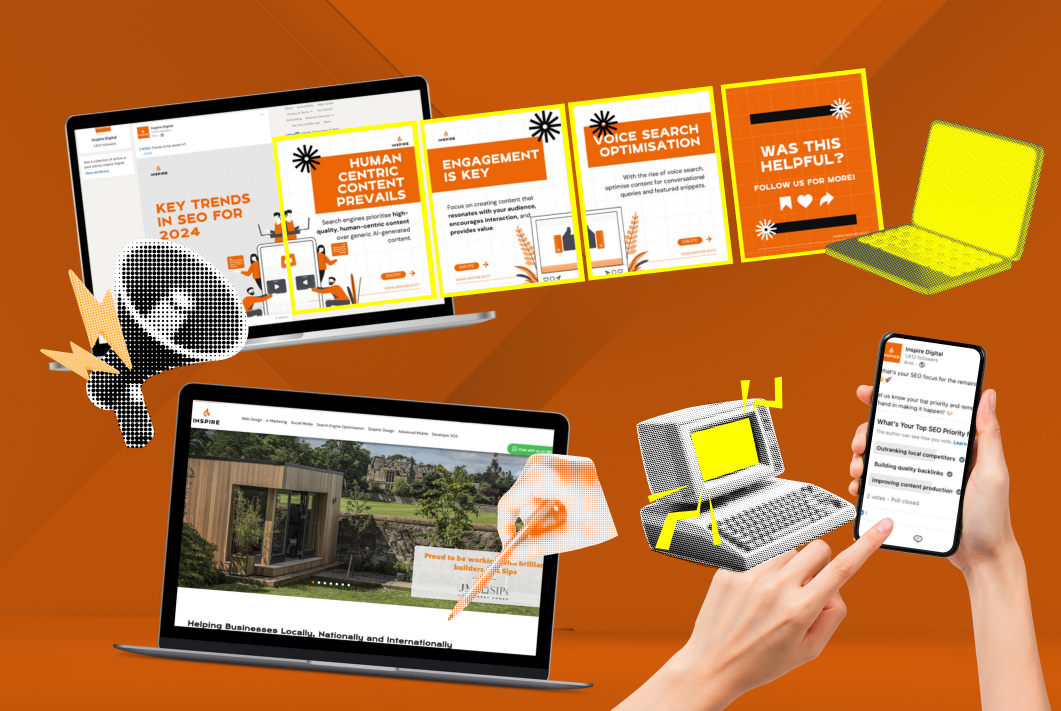
If you're feeling overwhelmed, don’t sweat it! Inspire Digital is here to lend a hand.
We’ve got loads of experience managing social media accounts for our clients all around Glasgow, tailoring our approach to fit each unique need.
Let us take the reins on your social media strategy, so you can focus on what you do best: growing your business and delighting your customers. Get in touch with us today to discover more.