A Comprehensive Guide to Generative Engine Optimisation (GEO)
Landing on top of Google search results has always been the goal for businesses looking to stay competitive online. And with the help of Search Engine Optimisation (SEO), brands have had the tools to boost their visibility in the digital space.
However, the online landscape is changing fast. Where businesses once had to optimise solely for search engines, they now need to optimise their site for AI platforms that provide immediate, conversational answers to users’ questions.
This is now what we call Generative Engine Optimisation – a new strategy for boosting your visibility on the search results of AI-driven search engines.
As one of the top-rated digital marketing agencies in Scotland, we stay ahead of these changes, so our clients can continue to thrive in a competitive market. In this guide, we’ll break down everything you need to know about Generative Engine Optimisation (GEO), and how to future-proof your business by integrating it into your digital strategy for 2025!
The Evolution from SEO to GEO
You could say SEO began with the launch of the first web page in 1991. But it wasn’t until Google revolutionised the scene in 2000 that SEO became more prominent and structured.
Two decades and countless algorithm updates later, SEO has become a key element in digital marketing - a strategy no business or marketer can afford to overlook if they want to succeed online.

But just as businesses have built and refined their SEO strategies, another major shift has arrived: Generative AI. With the rise of generative engines, users began experiencing the power of AI first-hand - asking questions and receiving instant, in-depth answers without ever clicking a single link. This changed how users behave in search engines, with click-through rates (CTR) declining by 30% with the launch of AI overview feature in Google.
This shift only means one thing: AI continues to reshape how we search, and the SEO landscape evolves with it too. Thus, the creation of Generative Engine Optimisation: a new approach to visibility in an AI-driven search world.
How Generative Engines Work
When ChatGPT shook up the world in 2022, it paved the way for other companies to harness the power of artificial intelligence with the launch of platforms such as Bing Copilot, Perplexity, and Google Search Generative Experience (SGE). These tools are part of a growing category known as Generative Engines.
You might ask, “How is this different from a traditional search engine?”
Let’s answer that with a simple scenario:
If you search “how to make homemade ice cream” using traditional search engines like Google, Bing, or Yahoo, you'll get a list of links to websites that may contain the answer. You then choose which site to click and read to find the information you need.
But when you search the same query using a generative engine like ChatGPT or Google's SGE, it instantly compiles a detailed, conversational response - listing ingredients, outlining the steps, and delivering the answer right away. There’s no need to click on multiple links, because the engine has already gathered the information for you.
Where do generative engines gather this information?
Generative engines don’t pull answers from a single source. Instead, they scan and process data using methods like web scraping and crawling, accessing public data sets, or even customer data (but of course, with proper consent from the user).
These engines use AI models trained on large datasets to understand context, summarise relevant points, and generate coherent responses.
The role of structured data, trust signals, and semantic clarity
If you’re wondering how your content can be picked up and used by generative engines, you should be aware of these three elements: structured data, trust signals, and semantic clarity.
By integrating structured data, you help AI better understand the context and hierarchy of your content, making it more likely to be featured in AI-generated responses.
Likewise, building trust using backlinks from reputable sources, positive user reviews, and up-to-date HTTPS protocols help establish your website as a reliable source of information.
Finally, the use of clear, concise language and relevant keywords (also known as semantic keywords) helps generative engines interpret your content accurately. Content that directly and clearly answers user intent is more likely to be referenced in AI-driven search results.
Best Practices for Generative Engine Optimisation
With the rise of GEO, businesses must quickly adapt to these changes so they can stay relevant and competitive in the digital market. Let’s explore the best ways to integrate GEO into your digital marketing strategy this 2025:
Create a clear content structure
When it comes to GEO, content clarity is everything. Generative engines favour well-structured content, so they can easily scan, understand, and summarise key information.
Compared to traditional search engines that index and list web pages, generative engines pull direct answers from your content. This means if your site isn’t easy to read and digest, you risk being left out of AI-generated responses altogether.
Here’s how to structure your content effectively for GEO:
- Use clear headings and subheadings: Break your content into logical sections using H2s, H3, and H4s. Aside from helping readers navigate your content with ease, it also gives generative engines an idea what each section is about.
- Include FAQs: FAQs directly answer common user queries in a natural and concise way. Generative engines love this format because it mimics how users ask questions and how engines generate answers.
- Add summaries or key takeaways: Generative engines prioritise direct-to-the-point content. Adding short summaries or bullet-point takeaways at the beginning or end of sections helps engines identify and extract your content more easily.
- Use lists and step-by-step formats: Structured formats like bullet points, numbered lists, and step-by-step guides are easier for both users and engines to follow. The more you format your content this way, the more visible your content is to generative engines.
Clear, factual writing and answer-first format
Content relevance is important to generative engines: what you say and how you say it.
Generative engines are designed to understand natural language and deliver precise, contextually accurate responses to user questions. That means long-winded, vague, or overly salesy content won’t make the cut.
To make your content GEO-friendly, you need to:
- Use an answer-first approach: Start with the most direct, helpful answer to a user’s question, then expand with additional context or explanation. This shows how generative engines frame responses - short, clear, and to the point.
- Keep your language clear and factual: Use conversational language, avoid jargon, and get straight to the point. Generative engines look for trustworthy, well-written content that’s easy to understand and based on facts. You can cite reputable sources to back your claims.
- Stay updated and accurate: Outdated content can hurt your credibility and visibility. AI-driven engines want the latest and most accurate information. Review your existing content regularly to ensure you’re up to date with trends, stats, and practices.
Technical tips
Aside from optimising content, you should also take technicalities into consideration. Generative engines don’t just rely on what your content says. They also pay attention to how your site is structured, how easily it can be crawled, and whether it appears trustworthy and credible.
Here are three key technical area to focus on:
Scheme markup (structured data)
Schema is used to help search engines better understand the content of your website. It adds context to your pages by marking up things like articles, products, services, FAQs, reviews, and more.
By using structured data, you increase the chances of your content being picked up and presented in AI-generated answers.
Crawlability and indexing
If your site can’t be crawled, search engines, including generative engines, won’t be able to access the content of your website.
For proper crawlability, make sure that:
- Pages you want indexed are not marked “no index:
- Your sitemap is updated and submitted to Google Search Console
- Internal linking is logical and supports easy navigation
Author profiles and E-E-A-T signals
Generative engines value trust, which means E-E-A-T (Experience, Expertise, Authoritativeness, and Trustworthiness) should be a priority.
One easy way to establish trust is by including clear author profiles on your blog or content pages, especially for advice-based content. Add bios, credentials, and links to social profiles or other publications to show real human expertise behind the insights.
What NOT to do in GEO
Now that we’re done with the best practices, let’s move on to strategies you should avoid when optimising your site for generative engines.
As AI-driven platforms continue to evolve, they’re getting better at identifying low-quality, irrelevant, or manipulative content. To stay visible and credible, steer clear of these common pitfalls:
Keyword stuffing
Just like in SEO, overusing keywords can hurt your content’s performance. Generative engines favour natural, user-friendly language. Cramming content with repetitive keywords can come across as spammy and reduce your credibility.
Tip: Integrate keywords naturally and always prioritise clarity and readability over keyword density.
Vague claims
Generative engines prioritise content that have trustworthy, well-sourced information. When you include unsupported claims on your site, you risk your visibility on search engines.
Tip: Back up your claims with data, examples, or citations from credible sources. Be specific and actionable.
Thin content
Short, shallow pages that lack depth or fail to fully answer a user's query are unlikely to be selected by generative engines. These tools prioritise comprehensive, informative content that delivers clear value.
Tip: Focus on content that explores topics in depth, anticipates follow-up questions, and provides genuine insights your audience will find useful.
Types of Content That Win in Generative Search
Clear, conversational, and direct-to-the-point content is what generative engines love. So, what types of content can you create to provide value to your audience and improve your visibility in AI-generated responses?
Here are four high-performing content formats to focus on:
Guides
Generative engines aim to answer user queries in full, and comprehensive guides are built to do just that. Step-by-step tutorials, how-to articles, and in-depth explanations give AI plenty of clear, structured information to pull from.
Tip: Break down your content with headings, numbered steps, and summaries to make it even easier for engines to understand and repurpose.
Definitions
Definitions are perfect for answering specific questions. When users ask “what is…” or “define…”, generative engines pull precise, reliable definitions to respond quickly.
Tip: Write concise definitions near the top of the page, and follow with context, examples, or related terms to provide additional depth.
Q&A content
Generative engines like clear question-and-answer formatting bevause of the conversational nature of user prompts. FAQs also give your content multiple chances to match various long-tail queries.
Tip: Identify common questions your audience asks and answer each in its own dedicated section or page. Be direct, accurate, and informative.
Case studies
Generative engines favour content that is credible and backed by real-world data. Case studies showcase your expertise while offering valuable insights, storytelling, and proof of results - all of which contribute to trustworthiness.
Tip: Structure case studies with a problem-solution-results format and include statistics, client quotes, and outcomes to boost authority.
Generative Engine Optimisation in Action
To help you further understand what great content looks like for generative engines, let’s head over to Perplexity and see GEO in action.
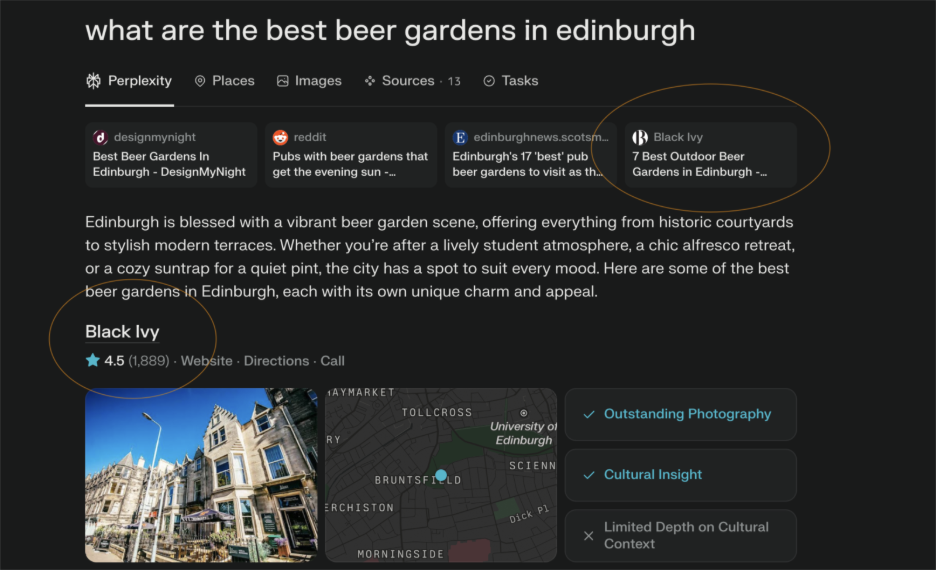
When you search “what are the best beer gardens in Edinburgh” on Perplexity, one of the top results is a blog from one of our clients, Black Ivy:The 7 Best Pubs with an Outdoor Beer Garden in Edinburgh
So, why did this blog stand out?
- It’s well-structured: The article uses a clear and consistent format-numbered headings, concise descriptions, and location details, making it easy for AI to understand and extract important details.
- It’s user-focused: The content delivers exactly what the searcher is looking for: a curated list of outdoor pubs with relevant details like ambiance, location, and what makes each place special.
- It’s current and credible: The blog is updated with accurate, up-to-date recommendations. It positions Black Ivy as part of the local scene, adding an authentic voice that builds trust with both users and search engines.
- It answers the query directly: The title is clear, and the content is hyper-relevant to the query. Generative engines reward content that is closely aligned with the user’s intent, and this blog nails it.
How to Measure GEO Performance
To set your website up for success in GEO, it’s important to understand what’s working and what’s not. While GEO is still an emerging field, tracking performance is possible by focusing on the right signals and tools.
Here’s how you can monitor and measure your GEO efforts effectively:
What to track
Unlike traditional SEO, GEO success isn’t measured by just clicks and keyword rankings. You’ll want to track:
- Website analytics: Look for increased traffic to specific pages that align with generative queries. A spike in organic traffic without a clear SERP boost might suggest generative engine visibility.
- Server logs: Monitor for unusual user-agent activity or referral patterns that don’t match known search engines. Some AI tools have unique identifiers you can filter in log files.
- AI referrals: Although limited for now, some platforms like Perplexity and ChatGPT are starting to credit sources. Keep an eye out for brand mentions or traffic from these tools.
Suggested tools for AI SERP monitoring
Because GEO is new, many traditional SEO tools don’t yet offer direct insights. However, there are a few options you can start with:
- Perplexity: Check how your content shows up for queries relevant to your niche. You can track visibility manually or use keyword variations.
- ChatGPT / Bing CoPilot: Try asking common customer questions and see if your brand or content appears in the AI-generated response.
- Brand monitoring tools: Tools like Mention, Brand24, or Google Alerts can help track when your content is referenced or summarised by AI tools.
Setting benchmarks and evaluating visibility
To evaluate performance over time, consider setting benchmarks such as:
- Pages with the highest visibility in generative results (track manually at first)
- Growth in branded search volume or direct traffic
- Increased impressions and engagement on informational content
- Frequency of inclusion in AI-generated answers (e.g., FAQs, definitions, guides)
You won’t always see a direct click path from generative engines, but visibility and mentions still build brand trust, authority, and long-term traffic.
What’s Next: Preparing for the Future of GEO
As AI-powered search engines become more prevalent, GEO becomes the future of digital discovery. With generative engines continuing to shape how users access information, marketers and business owners must be ready to evolve alongside them.
To stay ahead, it’s crucial to understand that GEO won’t stand still. In fact, it’s set to expand rapidly with the integration of:
- Multimodal AI: By 2034, the global multimodal AI market is projected to reach a staggering £31 billion. This means search engines can now read images, interpret videos, and understand combinations of media. If your content isn’t diverse and multimedia-ready, it could fall behind.
- Voice assistants: In 2025, over 20.5% of the global population uses voice search, powered by 8.4 billion voice assistants. That’s why optimising your content for natural language, spoken queries, and concise answers is a must.
- Real-time AI: Generative engines are becoming more responsive to current events and live updates. Content that is static and rarely refreshed risks being sidelined. Real-time relevance, dynamic updates, and agile publishing will become essential pillars of a GEO strategy.
Inspire: Your Partner in Navigating GEO
When it comes to navigating the GEO landscape, having the right partner by your side can help your business stay competitive. Understanding how AI-powered search works and knowing how to stay ahead of it is no small task.
That’s where Inspire comes in.
Our team stays at the forefront of digital trends, proactively adapting strategies to ensure our clients don’t just keep up with innovation but lead the way.
Why choose Inspire?
- Expertise you can trust: From SEO to GEO, we understand how search has evolved and what it takes to get your business discovered in the digital space.
- Tailored strategies: Each business unique, that’s why we take the time to understand your brand, your audience, and your goals, so we can craft a content and technical strategy that actually delivers results.
- Proactive mindset: As AI continues to change how users find and engage with content, we’re already working on what’s next.
- Transparent collaboration: We believe great results come from clear communication, shared goals, and a partnership built on trust.
- Ethical use of AI: Our company sets a clear boundary of when and how we use AI. We aim to be transparent to our clients by establishinga set of guidelines on how we integrate AI into our business.

Optimise Your Business for the Future of Search
GEO is transforming how users search. If you want your business to stay visible, competitive, and relevant in an AI-powered world, the time to act is now.
Whether you need a full GEO audit or tailored content strategies that align with how generative engines work, our team at Inspire is ready to help.
Contact us today and take the first step towards smarter, AI-optimised visibility!